
If you search for “home extension costs per square metre” in Ballarat, you see numbers ranging from $2,000 to $5,000.
These figures are confusing. They are often wrong.
The honest answer in 2026? A high-quality custom extension in the Ballarat and Daylesford region typically requires a budget between $3,500 and $5,500+ per square metre.
This price depends on site access, the number of wet areas, and structural complexity.
Relying on a square metre rate is the fastest way to blow your budget. Unlike a new build, an extension involves “structural surgery” on your existing home. Generic online calculators fail to account for demolition, heritage matching, hazardous materials, and rural site costs.
At Murphy James Builders, Tye and Daniel specialise in custom home extension builders throughout Ballarat, Hepburn Shire, and Daylesford. We meet homeowners caught in the gap between architectural dreams and financial reality.
This guide bridges that gap. It exposes the real extension design and build costs—from drafting fees to septic upgrades—most builders won’t discuss until you sign a contract.
Should I pay for architectural plans before getting a builder’s quote?
No. Committing to full architectural documentation before completing a feasibility check with a builder is the primary reason extension projects stall.
Nearly 50% of the plans we see are never built. The design costs significantly more than the client’s budget.
This is the “Design-Bid-Build” trap. You spend $10,000 to $15,000 on plans. You love the concept. Then you receive a construction quote $150,000 over your limit.
The Smarter Approach: Feasibility First
Do not pay for engineering and construction drawings yet. You need a reality check.
- Concept Sketch: Start with a simple floor plan sketch.
- Preliminary Estimate: Bring this sketch to a builder who offers detailed estimation.
- Feasibility Check: The builder tells you if the project fits your budget based on current material prices and site conditions.
WANT AN INSTANT ONLINE ESTIMATE?
The Three Stages of Documentation
Understanding what you are paying for helps you control costs.
- Concept Design: This is the “dream” phase. Floor plans and 3D elevations. This is enough for a builder to give you a price range.
- Town Planning: Required if you trigger a Heritage Overlay (common in Soldiers Hill or Ballarat East) or Vegetation Protection Overlay. This is for the council, not the builder.
- Construction Documentation: This includes engineering, geotechnical reports (soil tests), energy ratings, and detailed specifications. Do not order this until you know the Concept Design fits your budget.
Drafting Services vs. Architect Fees: Who Do You Need?
For many extensions, you do not need a full-service architect.
- Architects: Essential for complex sites, heritage-listed properties, or design-led projects with flexible budgets.
- Building Designers / Draftspersons: A cost-effective solution for practical extensions. Adding a master suite or open-plan living area fits here. They document your concept for less cost. This leaves more room in your budget for quality finishes.
We discuss this in detail in our guide to custom home planning costs.
Expert Insight: “A sketch costs nothing to change. A fully engineered set of plans costs thousands to redraw. Bring the builder in at the sketch stage.”
Why is the ‘cost per square metre’ higher for extensions than new builds?
Extensions lose the economy of scale found in new homes. Fixed site costs are amortised over a much smaller footprint.
When you build a new 250sqm home, the cost of the site supervisor, temporary fencing, toilet hire, and rubbish skips spreads across a large area. This lowers the rate per square metre.
When you build a 40sqm home extension, those fixed costs remain largely the same. They divide by a much smaller number.
The “Fixed Cost” Paradox
Let’s look at the math on “Site Setup” alone.
- New Build (250sqm): Site fencing, toilet hire, admin, and supervision might cost $25,000. That is $100 per sqm.
- Extension (50sqm): You still need fencing, a toilet, admin, and supervision. The cost might be $15,000. That is $300 per sqm.
You are paying 3x more per square metre just to have the builder on-site. This is why small extensions always seem expensive on paper.
The Efficiency Factor
Extensions are slower to build.
- Site Protection: Trades work slower in a lived-in renovation. We protect your existing floorboards. We seal off dust from living areas. We work around your family life.
- Manual Handling: In a new build, materials drop exactly where needed. In an extension, bricks and timber often need hand-carrying through side gates. This increases labour hours.
Cost Comparison Table
Cost Factor | New Build (250sqm) | Extension (40sqm) |
Site Setup | Low impact on total cost | High impact on total cost |
Demolition | Minimal (Site scrape) | High (Wall removal/Propping) |
Trade Efficiency | High (Open site) | Low (Restricted access) |
Protection Works | Minimal | Essential (Dust/Floor protection) |

How does the type of room impact the extension cost?
A “wet area” extension (bathroom/laundry) costs significantly more per square metre than a “dry area” extension (bedroom/living). This is due to the concentration of expensive trades.
This is where the “$3,500 per square metre” myth fails. If you add a master suite with a large ensuite, you build the most expensive rooms in a house.
The “Wet Area” Premium
- Dry Rooms (Bedrooms/Lounge): These are timber frames, plasterboard, paint, carpet, and simple electrical points. They are fast to build.
- Wet Areas (Bathrooms/Kitchens): These involve complex trade coordination:
- Plumbing: Rough-in and fit-off.
- Wet Area Waterproofing: A critical stage requiring multiple coats, bond breakers, and curing time to meet Australian Standards (AS 3740).
- Tiling: Labour-intensive floor and wall tiling.
- Joinery: Custom vanities and stone benchtops.
- Fixtures: Tapware, toilets, shower screens, and mirrors.
The Math: A cost of adding a bedroom (20sqm) might be $3,500/sqm. A 20sqm bathroom extension exceeds $6,500/sqm. Averaging them gives a blended rate. Looking at the rate alone misleads you.
Quotable: “When you add a bathroom, you build the most expensive part of a house without the cheap rooms to average out the cost.”
Case Study: Why 'Simple' Extensions Often Aren't Simple
The Lesson: This extension is architectural volume, not just extra space. A square metre rate would underestimate this build.
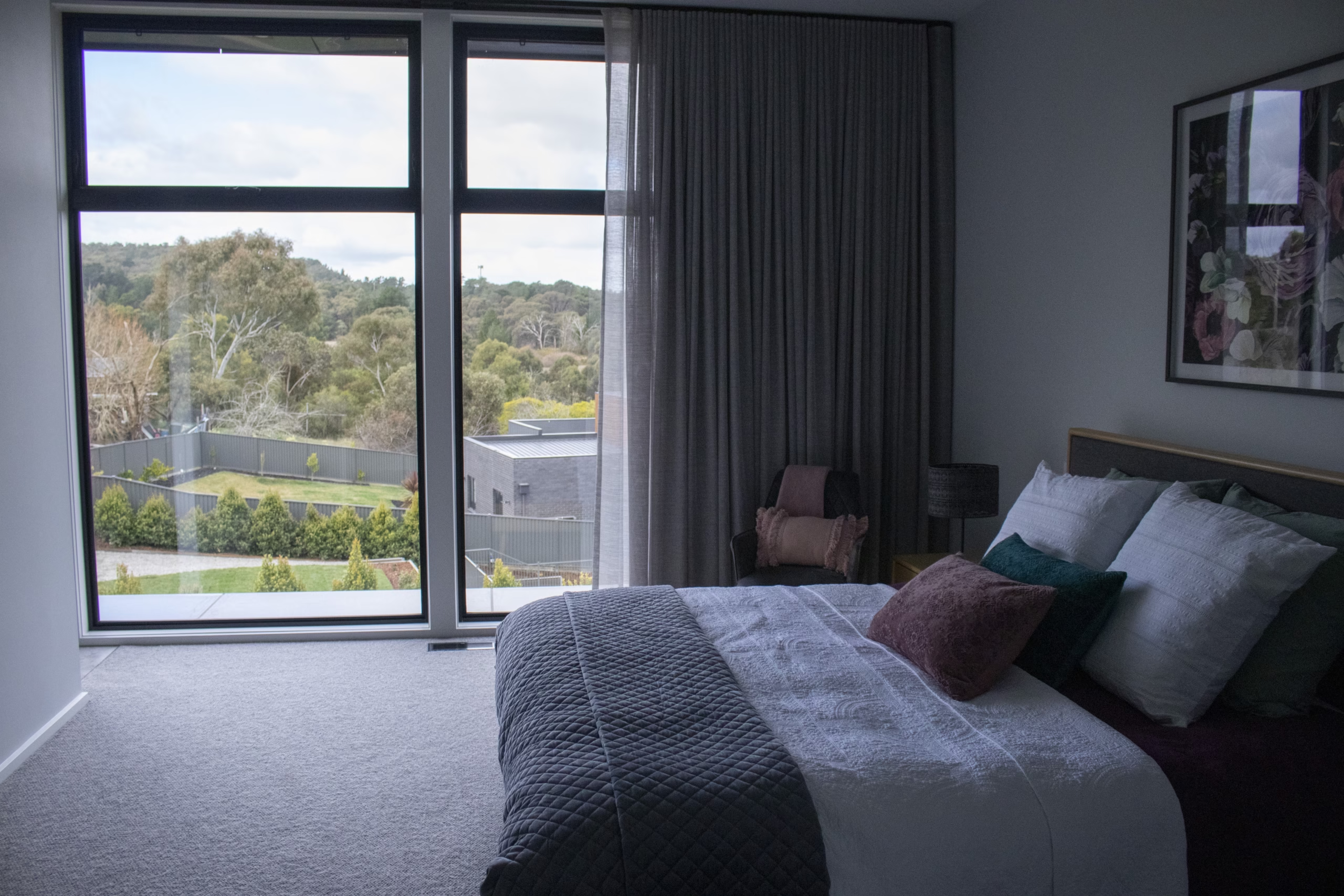
Take our project at Gladstone Street, Gordon. This custom extension transformed the home’s feel.
If you look at this project purely on floor area, the cost seems standard. The design featured high raked ceilings and three large skylights.
How Design Complexity Drives Cost (and Value)
- Raked Ceilings: A 4-metre high raked ceiling requires larger structural timbers. It needs more scaffolding. It demands more labour to plaster and paint than a standard 2.4m flat ceiling.
- Skylights: Large architectural skylights require complex framing, flashing, and waterproofing integration into the roofline.
The budget planned for features like light and height. The result is a light-filled space. This proves complexity drives cost more than size does.
What are the hidden costs of tying a new extension into an old house?
The most underestimated costs in an extension are the structural tie-in required to join the new frame to the existing residence.
You are grafting a new box onto an old one. This tie-in work creates variations if the builder misses details.
1. Demolition and Propping
Creating seamless open plan flow requires load-bearing wall removal. This is complex work. We install temporary props to hold up your roof. We insert heavy steel beams. We re-frame the opening.
2. Leveling and Underpinning
Old houses settle. A 1950s weatherboard home in Ballarat East might have floors 30mm out of level. Building a level extension joined to the old house creates a trip hazard. We pack or level the existing sub-floor. In some cases, we need underpinning to strengthen the old foundations before attaching the new ones.
3. Hazardous Materials (Asbestos)
Many homes in Ballarat built before 1990 contain asbestos. It hides in eaves, wet area sheeting, and vinyl floor tiles.
If we discover asbestos during demolition, work stops. A licensed removalist must remove it safely. This is a mandatory safety cost you cannot ignore.
4. Energy Efficiency Upgrades (7-Star)
New regulations (NCC 2022) require 7-star energy ratings. Sometimes, the new extension is compliant, but the “tie-in” makes the existing house non-compliant. You might need to upgrade insulation or glazing in the old part of the house to meet the total energy rating.
5. Scope Creep
Once the builder is on-site, you notice tired parts of the old house.
- “Paint the hallway.”
- “Upgrade the old switchboard.”
- “Replace the old carpet.”
These are valid upgrades. They are renovation costs. They need a separate budget allocation known as a contingency buffer.
WANT AN INSTANT ONLINE ESTIMATE?
What extra site costs apply to rural extensions in Daylesford and Ballarat?
Rural extensions trigger council requirements to upgrade existing infrastructure. Town projects do not face these wastewater and fire safety costs.
Extending on acreage in Mt Egerton, Gordon, or Daylesford requires looking at the infrastructure price.
Septic System Upgrades (LCA)
Adding a bedroom to a rural home increases potential occupancy. Hepburn Shire building regulations (and local Ballarat laws) often require a Land Capability Assessment (LCA).
- The Risk: If your septic tank is old or undersized, the LCA deems it non-compliant.
- The Cost: You install a new treatment plant and irrigation field. This costs between $15,000 and $25,000 before pouring the concrete slab.
Bushfire Attack Level (BAL)
Most rural properties have a BAL rating. A rating of BAL-29 or BAL-40 raises construction costs.
- Windows: You need specialised glazing and metal screens.
- Cladding: You must use non-combustible materials like fibre cement or BAL-rated timber (e.g., Spotted Gum).
- Water Tanks: The CFA mandates a 10,000L static water supply with CFA fittings for firefighting. This costs $5,000+.
Power Upgrades
Does your block have single-phase or three-phase power? A large extension with induction cooktops and air conditioning overloads old supplies. You might need a mains upgrade or sub-board.
Reactive Soil Sites
Ballarat and surrounds often have reactive soils (Class M, H1, or H2). These soils move with moisture changes. A geotechnical report (soil test) determines if you need a “waffle pod” slab or deeper concrete piers to prevent cracking. This costs more than a standard slab on stable sandy soil.
How does Murphy James Builders protect you from budget blowouts?
We replace provisional sum guesswork with a Fixed Price Building Contract backed by our 605-point quality assurance checklist.
Many builders win quotes using Provisional Sums. They guess allowances for things they did not quote properly. They put $15,000 for joinery. The kitchen you want costs $30,000.
The Murphy James Difference
We do not guess. We quantify.
- Detailed Procurement: We quantify every tap, tile, and door handle. This converts unknown costs into known Prime Cost (PC) Items.
- The 605-Point Checklist: We use a rigorous checklist throughout the build. We verify every stage from slab rebates to niche waterproofing. You can read more about our 6-point guarantee here.
- Direct Access: You deal directly with Tye and Daniel. We do not hand you to a junior supervisor who does not know your quote.
Why a Fixed Price Contract Matters
A “Cost Plus” contract means you pay for every hour and material, with no cap. A Fixed Price Building Contract gives you certainty.
Victoria’s consumer laws emphasize the importance of clear domestic building contracts to avoid disputes over variations. For more on what your contract should cover, refer to Consumer Affairs Victoria.
Our Promise: We prefer losing a project at the quoting stage by being honest about price. We will not win by hiding costs that stress you later.
Frequently Asked Questions About Extension Costs
It depends on overlays. A Heritage Overlay or Vegetation Protection Overlay usually requires a City of Ballarat planning permit. Standard residential zones that meet setback requirements typically require only a Building Permit. We handle this assessment during feasibility.
Extending out on the ground floor is cheaper. Second storey addition costs include:
- Scaffolding hire.
- Crane hire for lifting materials.
- Staircases (which eat up usable floor space).
- Structural reinforcement of existing walls and foundations to carry the new load.
- Additional insulation for the new roof and walls.
A standard custom extension takes 4–6 months to construct. The pre-construction phase including design, engineering, and permits takes an additional 3–5 months.
Ideally no, but sometimes yes. Living on-site slows down trades due to daily clean-up and safety requirements. This extends the timeline and increases labour costs. For major renovations involving roof removal or power cuts, moving out is often cheaper and safer.
In the current market, “transaction costs” (Stamp Duty and Real Estate Agent fees) on a new property often equal the cost of a small renovation. If you love your location, extending avoids wasting money on these fees. However, be wary of overcapitalisation—spending more than the finished house is worth. Our feasibility study helps you avoid this.
A Provisional Sum is a guesstimate for work not yet scoped (e.g., “Landscaping”). A Prime Cost (PC) Item is an allowance for a specific item (e.g., “Kitchen Tap”) and applies only if you select a more expensive tap. We aim to fix these costs upfront to avoid surprises.
Conclusion: The Real Cost Is Uncertainty
The true cost of a home extension is not just timber and concrete. It is the cost of uncertainty.
The most expensive extension is the one started on a guesstimate. Variations for rock excavation, septic upgrades, or structural propping hit halfway through the build.
A successful project requires more than a builder. It requires a feasibility partner who understands soil, council, and heritage constraints in Ballarat and Daylesford.
Stop risking your savings on a maybe.
Book a consultation with Murphy James Builders today. Let us turn extension anxiety into a fixed-price plan.